Classic 19" rack cabinets form the foundation of professional IT infrastructure. They facilitate the secure installation of devices, the organization of equipment, cable management, system expansion, and maintenance work. Depending on your needs, they can take the form of large floor-standing models, compact wall-mounted cabinets, or open structures designed for technical rooms.
In server rooms, data centers, and large-scale ICT environments, a 42U floor-standing rack may be the best choice. It provides space for servers, networking equipment, UPS power systems, patch panels, PDUs, and additional equipment. However, this does not mean that the largest or most elaborate server cabinet will always be the optimal solution.
Large floor-standing racks are heavy, take up a lot of space, and require a properly prepared working environment. Even smaller 19-inch rack models, such as a 6U or 12U wall-mounted rack, may prove too large for a simple monitoring system, a small network installation, or infrastructure that needs to be moved regularly.
In such situations, specialized 10-inch standard rack cabinets may be more practical. Their smaller dimensions allow for efficient use of available space, and a properly selected cabinet can simultaneously provide robust protection for the equipment, convenient installation, and easy access to the devices.
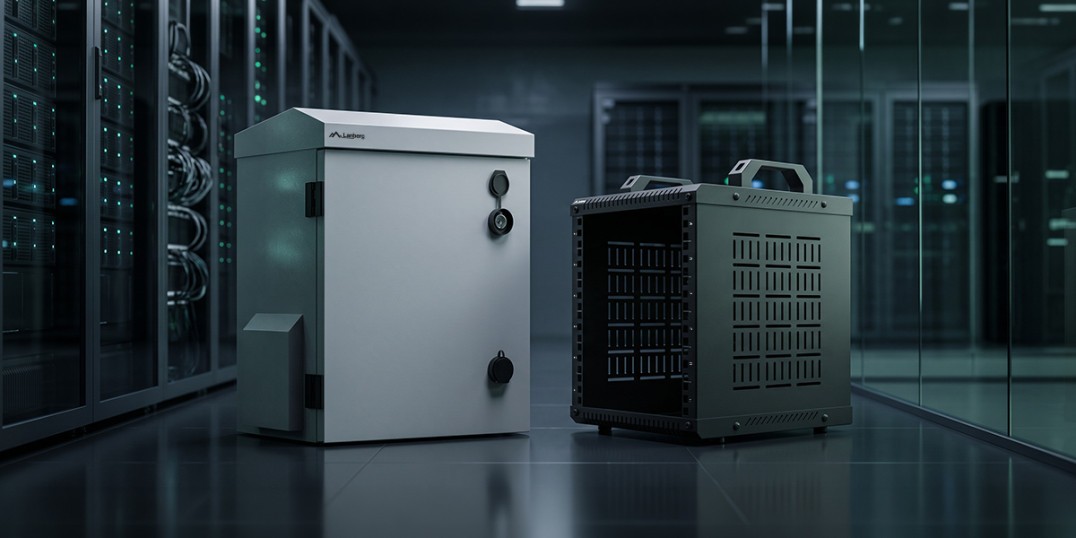
Lanberg offers a wide range of solutions designed not only for traditional server rooms but also for less typical applications. With installers, administrators, and integrators in mind, we have developed two new lines of 10" rack cabinets: hermetically sealed wall-mounted cabinets designed for demanding conditions and compact Open Rack designs that can be placed on a countertop, mounted on a wall, or easily moved.

Rack cabinets aren’t just for server rooms - places where a typical 19" rack won’t work
Rack cabinets are most often associated with server rooms, air-conditioned data centers, or dedicated technical rooms. In such locations, 19" rack cabinets allow network and server equipment to be consolidated into a single, organized system. They also provide adequate space for cable management, uninterruptible power supplies, fans, and other IT infrastructure components.
However, not every installation takes place under controlled conditions, and not every system requires a large amount of space for equipment storage. In some applications, a typical rack may simply be too elaborate for the actual needs.
One example is mobile setups used during events, broadcasts, training sessions, demonstrations, temporary deployments, and maintenance work. A single enclosure can house, among other things:
- a network switch,
- a router or firewall,
- a patch panel,
- a compact UPS,
- a data storage device,
- an automation controller,
- a CCTV recorder,
- telecommunications equipment,
- and components of a mobile workstation.
The ability to pre-assemble all components inside the cabinet reduces the time needed to set up the workstation at its final location. The installer does not have to build the system from scratch every time. All that is needed is to transport the ready-to-use configuration, set it up, connect the external cables, and start working.
However, a large 19" standard open rack—even one equipped with casters—may still be too heavy and bulky. If the system consists of only a few small devices, a classic freestanding rack would mean transporting a structure much larger than the equipment it holds. The depth of the rack can also be an issue, especially when transporting it in a passenger car or using it in a small service location.
Another area where standard rack cabinets do not always work well is outdoor installations. Most network devices and server racks are designed for indoor use. Controlled temperature, limited humidity, no precipitation, and secure access significantly reduce the risk of failure.
However, for surveillance systems, telecom operator infrastructure, IoT installations, industrial automation, or distributed residential networks, equipment must be placed much closer to the end point. Even the use of PoE switches with Extend mode or additional extenders does not always allow all connections to be routed from a single secure room.
As a result, equipment may be located on a building’s facade, a utility pole, a fence, a construction site, an industrial facility, or near an entrance gate. In such locations, a standard office-grade telecommunications cabinet will not provide adequate protection against water, dust, corrosion, mechanical damage, and unauthorized access.

Outdoor ICT Installations
When designing an outdoor ICT system, you must take into account far more factors than when installing equipment in a server room. Electronics are threatened not only by heavy rainfall, but also by moisture, fine dust, dust carried from roads and construction sites, sudden temperature changes, and industrial pollution.
Enclosures used outdoors must, above all, limit the ingress of water and dust into the equipment. At the same time, they cannot completely disregard the need for air exchange. Routers, PoE switches, recorders, power supplies, and controllers generate heat, so the operating conditions of the equipment also depend on proper air circulation.
Corrosion resistance is also important. An outdoor cabinet may be exposed to rain, snow, moisture, and fluctuating temperatures for many years. The enclosure material should therefore retain its properties and structural stability even after a long period of use.
Mechanical damage poses another risk. In public places, accidental impacts, being struck by a stone or bottle, attempts to force open the door, or other acts of vandalism cannot be ruled out. Therefore, a good outdoor rack cabinet should protect its contents not only from the weather but also from impacts and unauthorized access.
The method of installation is also of significant importance. A suitable wall is not always available at every location. In surveillance systems, operator stations, and distributed networks, equipment very often needs to be mounted directly on a pole. A suitable cabinet should therefore offer flexible adaptation to the deployment site and include the components necessary for its stable mounting.
The most important features of an outdoor ICT cabinet therefore include:
- compact dimensions allowing for installation close to the equipment being serviced,
- protection against water, dust, and moisture,
- resistance to corrosion and changing weather conditions,
- a robust construction that protects against mechanical damage,
- controlled ventilation that limits the ingress of contaminants,
- the ability to route cables in a sealed manner,
- lockable doors that secure access to the equipment,
- installation on both walls and poles.
Fortunately, we have exactly what you need.

Airtight Wall-Mounted Rack Cabinets for Outdoor Installation
The new 10“ airtight rack cabinets from Lanberg are designed for technical, industrial, and outdoor installations. They offer a compact alternative to traditional 19” rack cabinets when a system does not require a large amount of space but must be effectively protected from environmental influences.
The enclosure is made of AISI 304 stainless steel, which is characterized by very high corrosion resistance. As a result, the cabinet can be used in locations exposed to moisture, precipitation, and changing weather conditions.
The IP55 protection rating protects equipment from dust and water, including water jets from various directions. Meanwhile, the IK10 mechanical impact resistance rating enhances the equipment’s protection against impacts and acts of vandalism. This combination makes the hermetically sealed rack cabinet well-suited for outdoor surveillance systems, industrial installations, operator infrastructure, and IoT solutions.
The key advantages of the new series include:
- AISI 304 stainless steel construction – high corrosion resistance ensures a long service life for the cabinet in demanding operating environments.
- IP55 protection rating – protection of equipment against dust, rain, and water jets allows for safer outdoor installations.
- IK10 mechanical impact resistance – the robust construction reduces the risk of damage to the enclosure from accidental impacts or vandalism attempts.
- Wall or pole mounting – a complete mounting kit gives the installer greater freedom to choose the location.
- F7-class air filter – the filter, compliant with the EN779 standard, limits the ingress of dust and contaminants while supporting air circulation.
- Pre-punched holes and cable glands – enable safe, sealed, and organized cable routing into the cabinet.
- MESH panel – facilitates the installation of additional components and allows the interior layout to be tailored to a specific system.
- Two locks on the front doors – enhance protection against unauthorized access to the equipment.
- Full grounding of the structure – supports the safe operation of the installed equipment.
- Compact 10" standard – minimizes the space required without compromising professional equipment installation.
The Lanberg hermetically sealed wall-mounted rack cabinet can house, among other things, switches, routers, recorders, power supplies, alarm system components, automation controllers, and other network devices. It is ideal for CCTV installations in parking lots and residential complexes, access control systems, telecommunications infrastructure, industrial facilities, monitoring stations, and distributed IoT systems.
This solution is designed for installers who don’t want to choose between compact dimensions and effective equipment protection. The compact cabinet can be mounted close to cameras, access points, or sensors, reducing cable lengths and facilitating future maintenance.

A Sturdy, Mobile Base for Networking Equipment
Not every specialized rack needs to protect equipment from rain. In many applications, mobility, compact size, and quick access to equipment are the most important factors.
A portable rack system can be used by event companies, stage technicians, AV integrators, administrators managing multiple locations, service teams, surveillance installers, and organizers of temporary computer workstations. It can also serve as a mobile base for test or demonstration equipment.
A ready-to-use configuration can be prepared in advance at a workshop or company headquarters. Equipment assembly, power setup, and cable routing are then carried out under comfortable conditions. Once on-site, all that remains is to connect the system to the network, power source, and end devices.
This solution reduces the risk of errors when working under time pressure. It also makes it easier to verify that all equipment is present—all key components are stored in a single unit, rather than being scattered across separate boxes and cases.
For a mobile rack to function effectively, it should be:
- as compact as possible,
- easy to lift and carry,
- able to withstand the weight of the installed equipment,
- stable when placed on a countertop or other surface,
- open and easy to use,
- designed for organized cabling,
- equipped with effective ventilation,
- flexible in terms of device placement.
In this application, a closed rack-mounted server cabinet could hinder access to ports and cables. An open design works better, as it allows for quick diagnostics, reconnecting cables, or replacing a component without removing the side panels or doors.

Open-rack IT cabinet for mounting portable equipment
The Lanberg Open Rack 10" series was designed for compact IT installations where functionality, space-saving, and easy access to devices are key. The cabinets are available in various heights: 4U, 6U, and 9U. This allows you to choose a model suitable for both a simple home system and a more complex configuration used in a small office, service location, or at events.
The open design provides access to equipment and cabling from multiple sides. An installer can quickly connect cables, check connections, reconfigure, or expand the system without having to remove additional covers. This is particularly important in installations that frequently change their function or location.
The Open Rack 10" can be used, among other things, as:
- a mobile network setup for events or broadcasts,
- a compact internet distribution system,
- a base for a switch, router, and patch panel,
- a demonstration or training station,
- a portable monitoring system,
- an open cabinet for a home network,
- a setup for testing devices,
- an installation cabinet for a small office or service location,
- a base for automation, alarm, or access control devices.
The key advantages of the Lanberg Open Rack 10" series are:
- 4U, 6U, and 9U variants—allow you to adjust the cabinet’s capacity to the number of devices and available space.
- Wall-mount or tabletop setup – allows the rack to be used as both a stationary and a mobile solution.
- Integrated transport handles – facilitate moving the assembled configuration during installation, relocation, and workstation setup.
- Numbered 10" rack rails – help you precisely plan the layout of components.
- Four vertical mounting rails—ensure stable equipment mounting and good structural rigidity.
- Open access to devices—speeds up connection, diagnostics, service, and system expansion.
- Perforated panels—support natural ventilation and cooling of mounted devices.
- Cable tie mounting points – facilitate cable management and help keep the interior of the cabinet organized.
- Option to mount additional devices on the sides – allows you to attach, for example, a router, access point, or other auxiliary components.
- Cold-rolled steel – ensures durability and stable support for the mounted equipment.
- Static load capacity of up to 60 kg – enables the creation of a robust configuration consisting of multiple devices.
- Mounting accessories included – feet, M6 screws, and brackets allow you to start the installation more quickly.
Natural ventilation is one of the most important advantages of an open design. The free flow of air limits heat buildup without the need for a complex cooling system. Of course, this does not mean that every fan is unnecessary—thermal requirements always depend on the type and number of devices—but for typical switches, routers, and patch panels, the open design significantly supports stable device operation.
Equally important is the ability to route cables neatly. In a mobile system, loose cables can easily be pulled out or damaged during transport. Cable tie mounting points help keep cables in the correct position, facilitate diagnostics, and enhance the professional appearance of the entire setup.

Advantages of custom solutions: functionality, effective cooling, monitoring systems
The most advanced solution is not always the best one. A large server rack, an extensive ventilation system, and space designed for housing 19" equipment are essential in a data center, but they may unnecessarily increase the cost and scale of a small installation.
A good administrator, designer, and installer should, above all, correctly identify the system’s needs. What matters is not only the number of U units, but also the installation location, maintenance frequency, environmental conditions, risk of damage, required level of mobility, and planned expansion.
In one scenario, floor-standing racks with high capacity will be the best choice. In another, a small wall-mounted rack cabinet will suffice. If the installation is located outdoors, protection against water, dust, corrosion, and mechanical damage will be a priority. For a mobile system, features such as handles, an open design, low weight, good cooling, and quick access to equipment may prove more important.
Lanberg’s new 10“ rack cabinets address both of these scenarios. The hermetically sealed IP55 and IK10 models provide a secure space for monitoring systems, operator infrastructure, automation, and IoT installations. The Open Rack 10”, on the other hand, creates a robust, compact base for networking equipment that needs to be regularly serviced, configured, or transported.
Both series demonstrate that specialized racks do not have to be limited versions of classic rack models. They are solutions designed for specific operating conditions, and their greatest advantage is that their design is deliberately tailored to the user’s actual needs.
These are not the only custom rack cabinets that will be included in Lanberg’s product lineup. We will soon be expanding it with additional models, specifically designed for low-voltage installations, security systems, and compact ICT infrastructure.
Follow Lanberg’s news to stay up to date on upcoming releases and choose the solution best suited to your planned implementation.


