
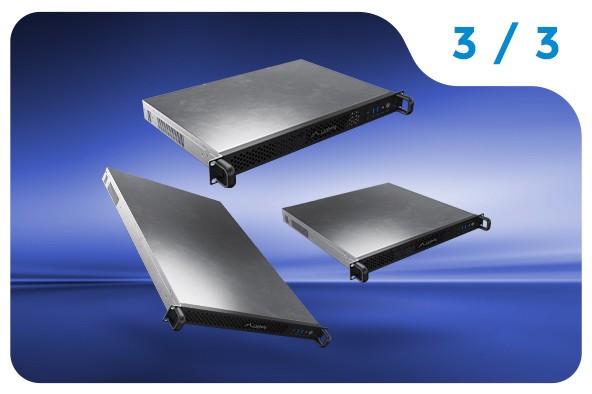
In the world of rack servers, the standard is 19“ (although 10” is also popular), and the height of the enclosure is measured in U units. Typically, manufacturers today offer rack server cases from 1U to 4U – and sometimes even 3U for special tasks. The taller the enclosure, the easier it is to fit more powerful components, ensure better airflow inside the enclosure, and make room for more powerful power supplies or larger cooling systems. However, in practice, “less” sometimes means “more”: in small server rooms, in wall-mounted cabinets, and in home offices, a 1U rack enclosure is the most compact and cost-effective solution.
Why? Because with a height of only 1U (i.e., 44.45 mm), the frame allows you to squeeze a 1U rack server into places where 2U or 4U designs—along with all the server infrastructure—simply won't fit. In times of rising space costs in data centers and working conditions with limited space, this approach brings a measurable economic advantage. Of course, there is also another side to the coin – a disadvantage in the form of more difficult cooling and limited expansion – but more on that in a moment.

1U RACK server – who is it for?
File server or LAN in rack cabinets at home: a small NAS with two or three drive bays can store your entire media library and family backups, hanging discreetly next to the patch panel.
SME corporate networks: a domain controller, print server, or lightweight virtualization node (e.g., Proxmox with AMD EPYC Embedded or energy-efficient Intel Xeon-D) will easily fit in a 9U rack.
CCTV/NVR: An IP recorder supporting a dozen or so surveillance cameras mainly needs space for 3.5" drives, and a 1U rack enclosure allows it to be mounted in the same column as a PoE switch.
Edge computing and telco: 1U is used as a MEC (Multi-access Edge Computing) node, SD-WAN firewall, or VoIP gateway in PBX systems.
Hobbyist labs: a Raspberry Pi cluster or “blade” composed of x86/Arm SBC rack computers will fit an experimenter's entire “cloud” into a single rail.
Audio-video: render farms, transcoding and streaming servers (e.g., live concert support) are often built on mini-ITX boards in 1U racks precisely because of their ease of transport in cases.

Advantages of a 1U server configuration
-
Small size – easy to install in 6-12U wall-mounted cabinets; fits where classic > 40U behemoths have no chance.
-
Lower infrastructure costs – a shorter, shallower cabinet means cheaper power strips, simpler cabling, and lower bills for cooling the entire room.
-
Flexible installation – 1U hangs in a garage, office alcove, music studio, or even an online store for POS hosting, without taking up valuable floor space.
-
Mobility – you can take a lightweight 1U server to an event or trade show as a demo appliance without worrying about excess baggage.
-
Modular scaling – instead of one large 2U rack, you build a farm of multiple 1Us and add more nodes when the demand for computing power really grows.
-
Environment management – in densely packed micro-nodes, it is easier to implement a “replace-in-place” policy by simply sliding a new unit into a free rail.

Problems arising from the RACK 1U server case
Cooling and ventilation
The height of 1U leaves only four centimeters for heat sinks. Smaller 40 mm fans have to spin faster, which increases noise and can be annoying in an office environment. In a 1U rack enclosure, any cable that obstructs airflow can raise the temperature of components by several degrees, and in a data center, force costly air conditioning overclocking.
Configuration: powerful processor, RAM, power supply
Modern CPUs – from AMD EPYC to Intel Xeon Scalable – achieve impressive performance today, but they can also consume up to 250 W. Such a processor, plus fast RAM and GPU accelerators, require both space and aggressive cooling. It is difficult to fit an extensive heat-pipe system into a 1U chassis, and a single power supply (especially when the customer does not opt for redundant power) operates almost at the limit of its specifications. Therefore, when designing a 1U rack server, it is not worth choosing the most powerful configuration possible right away – the risk of thermal throttling is simply too great.
Expansion and installation of disks
The compact format also means limited expandability. Typically, a 1U rack enclosure holds two to three 2.5" drives and usually does not offer hot-swap bays. As a company begins to accumulate more data, increasing storage space or migrating to a faster array becomes an operation that requires another cabinet or enclosure replacement. Similarly, adding a 100 Gb/s network card or a new NVMe module can be difficult because the only PCIe slot is already occupied by an HBA card.

New line of Lanberg 1U server cases
Despite the obvious limitations described above, the 1U format remains the golden mean where space economy and moderate performance requirements are important. That is why Lanberg, following the success of its 2U and 4U models, is now introducing a new series of 1U rack server cases addressing three main use cases – from mini-NAS to high-performance application servers.
SPECIFICATION OF 1U LANBERG MODELS
| Model | Key distinguishing features |
| Lanberg SC01-3001-10B – compact model (ITX) 300 | Minimum depth for small 19“ rack cabinets - 4 x 40 mm PWM fans + PWM splitter - supports 2.5” and 3.5" drives without adapters - dust filter, galvanized steel |
| SC01-4201-10B – universal model | ATX / ITX / micro-ATX / SSI CEB boards - space for three 2.5“ or 3.5” drives - 4 PWM fans + hub, ideal for SMB-NAS - galvanized steel construction |
| SC01-6501-12B – high-end model | One of the few 1U cases that can accommodate E-ATX and SSI EEB - up to 8 40 mm PWM fans + 2 hubs - reinforced 1.2 mm steel, space for 5 2.5“/3.5” drives - ready for HPC clusters and efficient database back-end |
Thanks to optimized air channels and pre-installed PWM splitters, the new models minimize the difference in practical functionality between 1U and 2U. Each variant is available from our official partners and distributors, along with mounting accessories.

Summary
There is no single “best” enclosure height—it depends on the specific assembly, budget, and installation. 1U, 2U, and 4U rack server cases coexist because they meet different user needs: from edge stations to large data centers. Lanberg offers a full range of well-designed, affordable solutions so that engineers and installers can choose the right equipment for their projects and take IT infrastructure management to the next level.


